Showing posts with label technology. Show all posts

Wednesday, June 23, 2010

Fuzzy Logic

* Understanding Fuzzy Logic

Fuzzy logic is an appropriate way to map an input space into an output space, with the methodology of solving problems with thousands of applications stored in the controlling and information processing. Fuzzy Logic provides a simple way to describe certain conclusions from the information ambiguous, vague - vague, or inappropriate. In a sense, fuzzy logic resembles human decision making with the ability to work from the interpreted data and finding the right solution.
Fuzzy logic is basically a much valued logic (multivalued logic) that can define the value of conventional circumstances, such as yes or no, right or wrong, black or white, and so forth. Fuzzy reasoning provides a way to understand the performance of the system by assessing the input and output system from the observations.

* History of Fuzzy Logic

In conventional logic truth value must have a condition that is true or false (true or false), with no conditions in between. This principle was put forward by Aristotle some 2000 years ago as a law of excluded Middle and legal logic has dominated the thinking until recently. But, of course thinking about the conventional logic with a definite truth value that is right or wrong in real life is not perfect. Fuzzy logic (fuzzy logic) is a logic that can represent the situation existing in the real world.
On the set of fuzzy logic theory was first proposed by Prof.. Lofti Zadeh around the year 1965 in a paper entitled "Fuzzy Sets'. He argues that the logic of right and wrong from boolean logic / conventional can not resolve problems in the real world. After that, since the mid-1970s, Japanese researchers have succeeded in applying this theory to practical problems. Unlike Boolean logic, fuzzy logic has a continuous value. Samar expressed in degrees of membership and a degree of truth. Therefore, something can be said to partly right and partly wrong at the same time. Set theory an individual can have a degree of membership with continuous values, not just 0 and 1 (Zadeh, 1965 in Asta, D.,: 2002).
With fuzzy logic set theory, we can represent and handle the problems to no certainty that in this case could mean doubt, inappropriate, inadequate information, and the truth which is partly (Altrock: 1997). In the real world, we often face a problem that information is very difficult to translate into a formula or numbers are accurate because the information is qualitative (can not be measured quantitatively).

* Reason Using Fuzzy Logic

A variety of reasons many people using fuzzy logic:

* The concept of fuzzy logic is easily understood. The underlying mathematical concept of fuzzy reasoning is very simple and easily understood.
* Fuzzy Logic is very flexible.
* Fuzzy Logic has a tolerance of data that is not appropriate.
* Fuzzy logic can model nonlinear functions are very complex.
* Fuzzy Logic can build and apply the experiences of experts directly without having to go through the training process.
* To be working with fuzzy logic techniques in the conventional control.
* Fuzzy logic is based on natural language.
* The set of fuzzy

Fuzzy sets: a group representing a condition under certain circumstances in a fuzzy variable
have two possibilities, namely:

* • One (1), which means that an item becomes a member in a set, or
* • Zero (0), which means that an item does not become a member in a set
*
* The set of fuzzy has two attributes:

* Linguistics, which is naming a group representing a particular state or condition by using natural language, such as: YOUNG, PAROBAYA, TUA
* Numerical, that is a value (number) that shows the size of a variable such as: 40, 25, 35
* Fuzzy Inference System

Fuzzy Inference System (Fuzzy Inference System / FIS) is also called fuzzy inference engine is a system that can perform reasoning with principles similar to humans do reasoning with her instincts.
There are several types of FIS which is a known Mamdani, Sugeno and Tsukamoto. FIS is the most easily understood, because most suited to the human instinct is the Mamdani FIS. FIS is working based on linguistic rules and has a fuzzy algorithm that provides an approximation to enter mathematical analysis.
Processes in the FIS is shown on the input provided to the FIS is a certain number and the output must also be a certain number. The rules in the language of linguistics can be used as an input that is accurate must be converted first, then perform reasoning based on rules and reasoning to convert these results into output that is accurate.
Our group will discuss the Fuzzy Inference System using Mamdani method.

* Mamdani Method

In this model, fuzzy rules are defined as:
IF x1 is A1 AND ... .. AND xn is An THEN y is B
where: A1, ... .., An, and B are linguistic values (or fuzzy sets) and "x1 is A1" states that the variable x1 is a member of the fuzzy sets A1.
Mamdani method is often known by the name of Max-Min method. This method was introduced by Ebrahim Mamdani in 1975.Untuk get the output required four stages:

* Establishment of fuzzy set

In the Mamdani method, both input and output variables are divided into one or more fuzzy.

* Application of the implication function

In the Mamdani method, the implication function used is the Min.

* Composition rules

Unlike monotonic reasoning, if the system consists of several rules, the inference obtained from the collection and correlation between the rules. There are three methods used in performing fuzzy inference systems, namely:

* Method Max (Maximum)

In this method, the solution fuzzy set is obtained by taking the maximum value of the rule, then use it to modify the fuzzy areas, and applying it to the output by using the OR operator (union). If all propositions have been evaluated, the output will contain a fuzzy set that reflected the contribution of each proposition. Generally it can be written as follows:
msf [xi] = max (msf [xi], mkf [xi]) with:
msf [xi] = membership value of fuzzy solution to the i-th rule
mkf [ix] = value of the consequences of fuzzy membership to the i-th rule

* Additive Method (sum)

In this method, the solution fuzzy set is obtained by means of bounded-sum of all output fuzzy region.
Generally written:
msf [ix] = min (1, msf [xi] + mkf [xi]) with:
msf [xi] = membership value of fuzzy solution to the i-th rule
mkf [ix] = value consequent fuzzy membership to the i-th rule

* Method Probalistik OR (probor)

In this method, the solution fuzzy set is obtained by doing the product of all output fuzzy region. Generally written:
msf [xi] = (msf [xi] + mkf [xi]) - (msf [xi] * mkf [xi]) with:
msf [xi] = membership value of fuzzy solution to the i-th rule
mkf [ix] = value consequent fuzzy membership to the i-th rule

* The assertion (defuzzy)

Input from defuzzy process is a fuzzy set obtained from the composition atuan fuzzy rules, while the output is a fuzzy set of numbers in it. So if given a fuzzy set in a certain range, it must be taken a certain crisp value as output.


Fuzzy

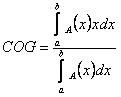
The most popular technique is the centroid technique. This method to find center of gravity (COG) of the aggregate set:


Centre of gravity (COG): finding a solution to the point that divides the area into two equal parts
Defuzzy is a mechanism to convert or change the results of the fuzzy output into a coherent output nonfuzzy. Output in the form of fuzzy results can not be directly used. In theory, fuzzy logic, there are several methods used defuzzy, namely:

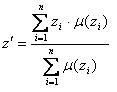
* Center of Gravity

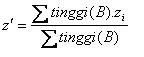
In this method, the crisp output is obtained by taking a regional center that covered the fuzzy membership function (z ') or can be written with the equation:
(2:19)
Center of gravity method surplus assertion lies in the results an acceptable reason (intutive plausibility), while the drawbacks lies in the intensive computational requirements.

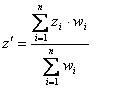
* Center of Average

In this method, the crisp output is obtained by taking a weighted average of the center w of n fuzzy sets. Crisp output can be mathematically defined by:


(2:20)
Assertion method of average or centroid center is the most widely used method in fuzzy systems and fuzzy control. In computing, this method is easier and more sensible.

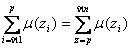
* Bisector

In this method, the crisp output is obtained by taking the value on the domain which has a fuzzy membership value of half of the total value of membership in the fuzzy area or can be written:
zp

such that (2.21)


* MOM (Mean of Maximum)

In this meode, crisp output is obtained by taking the average value of B domain which has a maximum value kenggotaan. Crisp output can be mathematically defined by:
(2:22)

* LOM (Largest of Maximum)

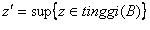
In this meode, crisp output is obtained by taking the largest value of B domain which has a maximum value kenggotaan. Crisp output can be mathematically defined by:
(2:23)

* SOM (Smallest of Maximum)

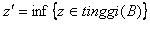
In this method, the crisp output is obtained by taking the smallest value of B domain which has a maximum value kenggotaan. Crisp output can be mathematically defined by:
(2:24)
read more...

Tuesday, June 22, 2010

DECISION SUPPORT SYSTEM

A.DECISION SUPPORT SYSTEM
One type of application system which is very popular among corporate management is a Decision Support System or abbreviated as DSS. DSS represents an information system that is expected to assist management in decision-making process. Things that need to be emphasized here is that the presence of DSS is not to replace the manager duties, but to be the supporting infrastructure (tools) for them. DSS is actually the implementation of the decision-making theories that telahdi introduced by sciences such as operations research and management science.Hanya difference is that if the first to seek settlement of their problems computation iterations must be performed manually (usually to find the minimum value, maximum, or optimum), the current PC has offered the ability to solve the same problem in a relatively short time.

In both fields above, the known terms of decision modeling, decision theory, dandecision analysis - which is essentially represent the management problems faced every day in the form of quantitative (eg in the form of mathematical models). Classic examples of problems in this field adalahlinear programming, gaming's theory, transportation problems, inventory systems, decision tree, and so forth. Of the many classical problems that are often encountered in activities of daily business, some dapatdengan easily simulated and solved by using formulas or simple formulas. But many problems are very rumitsehingga require sophisticated computer.

Sprague and Carlson DSS defines quite well, as the system has five main characteristics (Sprague et.al., 1993):

1) computer-based system;

2) Is used to help decision-makers;

3) To break down complex problems kanmasalah the "impossible" was done by manual calculations;

4) By way of an interactive simulation;

5) Where the data and analytical models as the main component.

6) Characteristics 4dan 5 is a new facility offered by the DSS recent progress in accordance with the latest developments in computer devices.


Concept of DSS:

- HERBERTSIMON: the distinction between decisions that in-program or not programmed, and the phases of decision-making

- GORRY & MICHAEL ANTHONY G. S. Scott Morton: the creation of lattice for the structure and level of management problems

- STEVENALTER: empirical support for the establishment of the basic topology DSS


1. DSS is devoted to support the manager:

• semi-structured problem solving,

• more emphasis on effectiveness than efficiency

2. DSS provides information for problem solving and communication skills.

3. Information obtained from: regular and special reports, output of mathematical models and expert system output.

4. Communication is done when a manager to do problem solving group.

B. DECISION SUPPORT SYSTEM COMPONENTS

o mathematical modeling is an integral component of profitable DSS managers (although it still contained a few flaws)

o Computer graphics: a study based graphics suitable to a particular situation; on the situation graph more effectively than others.


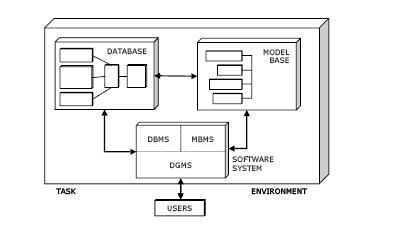
Overall DSS was built by the three major components:

1) Database

2) Base Model

3) Software System

Database system contains a collection of all the company's business data, both derived from daily transactions, as well as basic data (master files). For the purposes of the DSS, the necessary data relevant to the problems to be solved through simulations.

The second component is a Base model or a model that represents the problem into a quantitative format (mathematical model for example) as the basis of simulations or decision-making, including the purpose of the problem (objective), related components, the existing constraints (constraints ), and other related matters.

The second component is to further united in the third component (software system), having previously represented in the model that "understood" the computer. An example is the use of techniques RDBMS (Relational Database Management System), OODBMS (Object Oriented Database Management System) to model data structures. While MBMS (Model Base Management System) is used to present their solutions to search problems. Other entities are contained in the new DSS products are DGMS (Dialog Generation and Management System), which is a system to allow the "dialogue" between computer and human interactive (the user) as decision makers.

C. DSS KINDS

DSS applications are offered in the market is very diverse, from the most simple (and quick-hit DSS) to very complex (Institutional DSS). "Quick-Hit DSS" is typically intended for new managers learn to use the DSS (as the development of the type of reporting provided by MIS = Management Information System, satulevel system under DSS). Usually the problem is quite simple (simple) and required immediate resolution. For example for the need for reporting (report) or information retrieval (query). The same system is also used to make an ordinary simple analysis. Examples are seeing the impact that occurred in a formulation, if the variables or parameters are changed. Inside the company, the DSS of this type are usually implemented in an organization that can function stand-alone (based on data owned by that organization functions). Example is the DSS to prepare the annual budget, DSS for employee salary increases, the DSS to determine the amount of overtime hours employees, and others.


'Institutional DSS "is an application built by business experts and experts in the DSS. In accordance with its name, the DSS of this type are usually working at the company level, where data are owned by their respective organizations have integrated functions (created structures and connections are defined terms).

An example is the DSS to predict revenue in the future (forecasting) that will simulate the data derived from the Sales Division, Marketing Division, Logistics Division and Operations Division. Examples of implementations that are not less interesting is a system, whereby if the management has plans to layoff a few employees, will be able to simulate the impact on the balance sheet profit and loss firms. Examples of application of other DSS's most widely used in the business world is for the purposes of analysis, marketing, logistics and distribution operations, and the problems associated with finance and accounting (Taxation, budgeting, etc..).

A. GRAPH-BASED SYSTEM

In merepresenasikan DSS so you can easily be used and understood by all users (in this case is the manager of the company), the absolute graphics format used to complement the existing text. Examples of popular graphical models used are as follows:

ü Time SeriesCharts - to see the impact of a variable versus time;

ü Bar-Charts to compare the performance of several entities;

Pie Charts ü-to see the composition or the percentage of a thing;

ü ScatteredDiagrams - to analyze the relationship between several variables;

ü Maps - to represent geographic data;

ü Layouts - to describe the location of physical goods, such as in buildings and offices;

Hierarchy Charts ü-to describe the organizational structure;

ü-Sequence Charts to represent something with the logic that tersetruktur (examples are flowchart diagrams); and

ü Motion Graphics-to show a behavior of the variables observed by the animation.

The types of the graph above can usually be displayed in two formats: two dimensidan three dimensions.

B. DSS DEVELOPMENT

DSS is currently popular for use are based on tables or spreadsheets, because managers are used to read data in this way. The table here is the media manager in "mengkutak-katik" (replace or modify) an existing variable, where the results will be displayed in graphical formats that have been described previously. For this purpose, usually a stand-alone PC is enough to implemented the mentasikannya.Sejalan with developments in information technology, has offered many DSS applications that work within the network infrastructure (LAN, WAN, Intranet, Internet, etc..). Some managers attributed the decision maker with one another via a computer network, so that they can exchange a stream of data and information for decision making. Even the existing DSS yangdiperlengkapi with expert system (based on artificial intelligence theory = artifial intelligence), so that business decisions can be made directly by the computer, without human intervention.


C. PURPOSE DSS (Peter G. W. Keen & Scott Morton)

a) Assist the manager to make decisions for dealing with semi-structured,

b) Supporting the consideration of the manager, not as a substitute for consideration of managers,

c) Improve the effectiveness of managers in making decisions (not efficiency).


Three Principles of the Basic Concept of DSS:

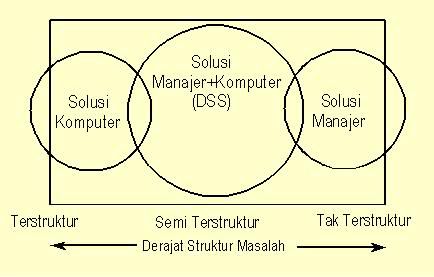
1. Problem Structure: Problems in the form of structured or unstructured difficult to find, the majority of semi-structured form of the DSS is aimed at the area where many of the problems found.

2. Decision Support: DSS is not a substitute manager

• Computers used for any portion of a structured problem, was the manager responsible for the portion of unstructured problems (with applications consideration, intuition, or analysis).

• Computer & Managers as problem-solving teams in semi-structured problems.

3. Decision Effectiveness Ù benefitfrom using DSS is playing better decisions

• Not always the best decision; in many cases where managers decide the best alterternatif.

• Additional time for the optimum solution with increasing precision is not worth much.

• Managers use considerations (judgment) to determine manayang decisions contribute to the solutions.


Figure 1. DSS focus on Semi-Structured Problems

These types of decisions

• Decisions are programmed (structure)

- Created by customs, rules, procedures, written or not

- Form a routine, repetitive

• Decisions are not programmed (not structured)

- Regarding the special problems, unique, unusual

- Policies that are not answered

Mis.Pengalokasian resources


CONCLUSION

From the explanation, it can be concluded that the DSS is:

· Sistember basiskomputer

· System that produces a variety of alternative decision

· System that helps decision makers (decision maker)

· System that solves the problem of semi / unstructured

· System that uses data, databases, and model makers.
read more...

Friday, June 4, 2010

KNOW TECHNOLOGY Android


GOOGLE AS A DEVELOPER Android

Abstract:
Android is a software platform for mobile devices powered by Google OS, originally developed by Google and later the Open Handset Alliance. This allows the developers to write managed code in the Java language, the control device through the Google developed Java libraries. Applications written in C and other languages can be compiled to ARM native code and running, but the construction of this road is not officially supported by Google.
Android is an open operating system intended for mobile devices (mobile device). Dikembagkan by the Open Handset Alliance, which consists of software developers, hardware and providers such as Google, HTC, Intel, Motorola, Qualcomm, T-Mobile, and NVIDIA which aims to create an open standard for mobile devices (mobile device). As of July 2005 had been acquired by google android on 5 November 2007 and then officially released by Google's Android. In the development of android applications Android SDK provides the tools and APIs to provide application developers with flatform android. Android using Java as the language pemogramannya, so for those of you who've been playing with java it never hurts to try Android.
Keywords: android, google

Preliminary
In July 2005, Google acquired Android, Inc., a small startup company based in Palo Alto, California, United States. Android's co-founders who went to work at Google included Andy Rubin (co-founder of Danger), Rich Miner (co-founder of Wildfire Communications, Inc.), Nick Sears (once VP at T-Mobile), and Chris White (head of design interface and development in Webtv). At that time, little is known about the functions of Android, Inc. other than those who create software for mobile phones. This began rumors that Google has plans to enter the phone market, although it 's not clear what the function might do in the market. At Google, a team led by Rubin, who developed the mobile device platform backed by Google's OS that is marketed to handset makers and operators on the premise of providing a flexible, upgradeable system.

Systems Development Method
Developing Java Applications library written in C and other languages
Company founder is the Open Handset Alliance. Sources flagship model is the open source and free software. Android 21 October 2008 released earlier. Monolithic Kernel Kind Linux. License Apache 2.0 and GPLv2. Android is a software platform and operating system for mobile devices, based on the Linux kernel, originally developed by Google and later the Open Handset Alliance. This allows the developers to write managed code in the Java language, the control device through the Google Java libraries developed applications written in C and other languages can be compiled to native code and run ARM, Opening of the Android platform on 5 November 2007 have been announced to establish a consortium of 48 hardware, software, and telecom companies devoted to advancing open standards for mobile devices. Android from code licensed under Apache, a free software and open source licenses.
In July 2005, Google acquired Android, Inc., a small startup company based in Palo Alto, California, United States. Android's co-founders who went to work at Google included Andy Rubin, co-founder of Danger, Rich Miner co-founder of Wildfire Communications, Nick Sears once VP at T-Mobile, and Chris White's head interface design and development in Webtv At that time, little is known about the functions of Android, Inc. other than those who create software for mobile phones. This began rumors that Google has plans to enter the phone market, although it is unclear what the function might be doing at Google pasar.Di, a team led by Rubin, to develop Linux-based mobile OS that is marketed to handset makers and operators on the premise of providing a flexible , upgradeable system.

Android at the Googleplex.

Reports from the BBC and The Wall Street Journal that Google has developed a Google-branded handset. More speculation followed that statement because Google has determined the technical specifications, he showed the prototype to cell phone manufacturers and network operators. As many as 30 prototype phones are reported to operasi.Google has filed several patent applications in the fields of cellular phones.
"The announcement is more ambitious than today's single 'Google Phone' that the press has been speculating about for weeks. Our vision is our strong platform that will power the opening of thousands of different phone models." - Eric Schmidt, Google Chairman / CEO

On November 5, 2007, the Open Handset Alliance, a consortium of several companies including Google, HTC, Intel, Motorola, Qualcomm, T-Mobile, Sprint Nextel and NVIDIA, was unveiled with the aim to develop open standards for mobile devices. Along with the formation of the Open Handset Alliance, the OHA also unveiled their first product, Android, mobile devices platform built on Linux kernel version 2.6. On December 9, 2008, he announced that 14 new members will join the Android project, including: Sony Ericsson, Vodafone Group Plc, ARM Holdings Plc, Asustek Computer Inc., Toshiba Corp. and Garmin Ltd..

Google Chairman and CEO Eric Schmidt took a few times in the official press release to remove all previous rumors and speculation about the existence of Google phone independent. Android has been available in the form of open source. Google opens the source code (including the telephone network and the previous arrangement was not available, under the Apache license.

With the Apache License, vendors are free to add extensions ownership without sending them back to the open source community. Android has been criticized for not all open source software despite what was announced by Google.: The SDK is an exclusive and closed-source and believe this is so that Google can control the platform.

4. Results and Discussion

History
July 2005, Google acquired Android, Inc.., A rapidly growing company headquartered in Palo Alto, California, United States. Founder of Android, Inc.. including the Andy Rubin, Rich Miner, Nick Sears, and Chris White. But at this moment only a handful of people know the functions of Android, Inc.. in addition they are making software for mobile phones. Rumor had developed when Google acquired Android, Inc.. that Google is planning to enter the phone market is not yet known but will like what Google's share of the world's mobile phones.

At Google, a team led by Rubin developed a basic platform of mobile devices with the Linux kernel which was sold to handset makers and telecom services. As the news circulated that Google already has hardware components and levels of software partners and signaled to the telecommunications service provider that they offer is open. Speculation about Google's targeted for mobile phones are increasingly growing that they will soon announce it in the month of December 2006. More and more rumors saying that Google is developing Google branded mobile phone. There are as many as 30 prototype phones are reported to have functioned at that time.
September 2007, Google filed a patent is known in the field of cellular phones.
Development
Android has experienced since the launch of first renewal.

Cupcake
30 April 2009 was officially launched Cupcake with several new features:
The ability to record and play video in camcorder mode
Upload videos to Youtube and photos directly from mobile phones to Picasa
Keyboard with soft keys features "autocomplete"
Ability of a direct connection to a Bluetooth headset
Widgets and the new folder
Animation
Improved copy-paste capabilities
Donut
15 September 2009, Donut (Donut) launched:
Android Market update
Interface cameras, camcorders, and an integrated gallery
Elimination of photos in the gallery can be done in multiple (many files)
Voice Search updated with faster response and better integration with the ability to call contacts
Improved search features for bookmarks, history, contacts, and web directly from the standby display
Updates technological support CDMA / EVDO, 802.1x VPN, Gesture, and Text-to-speech
Improved speed in the search
Eclair
October 26, 2009
Improved hardware speed
New applications "Car Home"
Support the resolution and screen size developed
The new browser interface
List of new contacts
Black-white ratio for better background
Google Maps 3.1.2
Microsoft Exchange Support
Support for camera flash
Digital zoom
Virtual keyboard repaired
Bluetooth 2.1
Android soulless devices
The first devices running Android operating system and is widely marketed is the HTC Dream which is released on October 22, 2008. By the end of 2009 certainly will circulate around 18 phones using Android.

Android will be launched with core applications (See the top layer is application layer) such as email client, SMS program, calendar, maps, browser, contacts. All applications are written using Java.


Then Look at the second layer (Arsitektor Framework API).


Developers have full access to the same used by the Application Core (Core Application), so developers can change the default standard application browser, email client, SMS program browser.email applications such as client, SMS made by developers themselves. Developers can use the available components to develop or modify new applications. For example Look at the view system framework, with a view component system, the Developer can use to build user interface components including lists, grids, text boxes, buttons and components in a web browser. This can summarize the progress of time the developer team. Content Provider Framework enables applications to access data in other applications such as Contacts or can also divide the data into other applications.
If not satisfied by utilizing a second layer, there is a third layer containing the Library. This third layer is a layer that can also be found on other operating systems, within the existing layer components are written in the native language C / C + +. The difference of Android Runtime components. In runtime, the available library functions of the Java Programming Language.

Every Android application, running on its own in-process instance (the Indonesian language, why?) By Dalvik Virtual Machine. Dalvik governing this is the low-level threading and memory management. Dalvik Virtual Machine works just like the Java Virtual Machine and BREW runtime. Dalvik Virtual Machines execute files in the format. DEX (dalvik Executable), VM is register based and run the classes that have been compiled by the Java Language Compiler.

Bottom layer or the number four is the most important layer of the Linux Kernel version 2.6 to serve the core operating system services such as security, memory management, process management, network stack and driver model. Kernel also acts as an Abstraction Layer between hardware and software stack.


There are four basic that we must understand in building Android-based applications:
Activity, is a graphical interface that we see when running an application. applications can have more than one Activity
Intent, is a set of values that indicate what should be done when there is movement of the screen
Service, is a service that works in Backend
Content providers, enables an application to store and receive data from the database.

Android Application

Released (preinstalled)

HTC Dream (T-Mobile G1)

The HTC Dream (also marketed as the T-Mobile G1, G1 era in Poland, Dream Rogers in Canada) is the first to market phones that use the Android platform. The phone is part of the open standards efforts of the Open Handset Alliance.

The Magic HTC. The Magic Dream similar but without the slide-out keyboard, rather than using a keyboard on the screen.

China launched its version of the company Qigi i6 (formerly Windows Mobile) devices running Android on the moon in December 2008. Devices manufactured by Chinese ODM TechFaith.

HKC Pearl, who claimed to dual-boot Windows Mobile 6.1 and Android.

HKC Imobile v413, build a similar Android HTC Touch.

Samsung I7500 announced in April 2009 for release in June.


Released (aftermarket installation)
Some users have been able (with some amount of hacking, and with limited functionality) to install Android on other mobile devices that shipped with the OSes:

The OpenMoko phone (Neo 1973 and Neo FreeRunner) is also very supportive since the release of Google Android source code on October 21, 2008. On November 4, 2008, all the source compiles the stack, with the kernel, users and most applications work, but the phone, SMS, suspend / resume and wifi, which relies on low-level hardware features, does not fully work. In early 2009 Cupcake and pictures that show is available as a flashable image

Motorola A1200 Sun

HTC Kaiser: port is in progress, all features are not functioning at this time

HTC Vogue

HTC Touch Diamond: Not all functions work (including Wifi

HTC Touch Pro

Nokia N810

Nokia 770

Asus EeePC 701

Asus EeePC 1000H

Book of touch Always inovati

Dell Axim x51v

HTC Touch HD: similar to the Touch Diamond, not all features function as wifi and audio during voice calls

Upcoming

In September 2008, Motorola has confirmed that he worked on hardware products that will run Android.

Huawei plans to release a phone that will run on

Android T-Mobile. This however does not set a date until June 2009 after.

Archos plans to launch a new device, which will incorporate a significant media capabilities with Android OPERATING system.

Lenovo's working on Android-based phone that supports China's 3G standard TD-SCDMA.

HTC is planning a "portfolio" of Android-based phone. which will be released in the middle of 2009, including HTC Magic, unveiled on February 17, 2009 at 2009 Mobile World Congress in Barcelona, Spain. The Magic HTC will be released with the "Cupcake" built with his debut on May 5.

Sony Ericsson is waiting for better multi-media support for Android 2.0.

GiiNii Movit Mini is an Internet device based on Google's Android operating system.

Acer is rumored to be releasing a phone called the L1, C1, E1, F1, and A1 (unconfirmed) at the end of 2009.

ODM Yuhua of China's first Android phone, dual SIM DSTL1 will be released in June under the General Mobile brand. The Company is planning more Android devices.

Skytone, distributors and software developers from Skytone Alpha-400 netbook announced a release of Android, the Alpha-680.

Kogan Technologies, Australia's manufacturing technology, has announced the Android compatible fit: in Kogan and Kogan agora agora Pro. This match is scheduled to be released on January 29, 2009. In mid-January 2009, Kogan announced that an appropriate release has been delayed indefinitely agora.

Android Excellence

Some key advantages that distinguish devices on the Android platform from similar products:

1. Openness - Android provides access to the basic functions of mobile devices using standard calls to the API.

2. The destruction of the border - you can combine information from the Internet into the phone, such as contact information, or data on the geographical location to get a new chance.

The similarity of applications - for Android is no difference between the main phone applications and other software - you can even change the program to dial the number, or screen saver.

4. Quick and easy development - in the SDK has everything you need to create and run Android applications, including instrument simulator, and advanced debugging tools.

Software Development

Early feedback on the development of applications for the Android platform have been mixed. Issues cited include bugs, lack of documentation, inadequate QA infrastructure, and no public issue-tracking system. (Google's issue tracker which was announced on January 18, 2008) In December 2007, MergeLab mobile startup founder Adam Macbeth stated, "Function does not exist, are poorly documented or just does not work ... This is clearly not ready for prime time." Although Thus, targeted Android applications have begun to emerge in a week after the platform was announced. First commonly available is the application of Snake game. The Android Dev-open phone is SIM unlocked and hardware devices that are designed for advanced developers. While developers can use a device commonly purchased retail consumers to test and use the applications, some developers may choose not to use the retail device, selecting an open or no-contract device.


4.7 Software Development Kit
Android SDK includes a comprehensive set of development tools. It includes debugger, libraries, a handset emulator (based on QEMU), documentation, sample code, and tutorials. Currently supported platforms include the development of x86-architecture computer running Linux (any modern desktop Linux Distribution), Mac OS X 10.4.8 or later, Windows XP or Vista. Requirements also include the Java Development Kit, Apache Ant, and Python 2.2 or newer. Which are officially supported integrated development environment (IDE) is the Eclipse (3.2 or newer) to use the Android Development Tools (ADT) Plugin, although the developer can use any text editor to edit Java and XML files and then use the command line tool to create, build and debug Android applications. Preview release of the Android software development kit (SDK) has been released on 12 November 2007. On July 15, 2008, the Android Developer Challenge Team accidentally sent an email to all entrants in the Android Developer Challenge has announced that the new SDK is available in "private" Download. Email is meant for the winner in the first round in the Android Developer Challenge. Derived that Google has provided a new release of the SDK for other developers and some do not (and maintain this arrangement private) has been reported to cause a lot of frustration within the Android developer community.
On August 18, 2008 in Android 0.9 SDK beta was released. This release provides an update and expansion of the API, the improvement and development tools
updated for the design of the home screen. Detailed instructions for upgrading are available for those who have worked with previous releases. On December 23
September 2008 the Android SDK 1.0 (Release 1) has been released. According to the release notes, he included "mainly bug fixes, although some smaller features added." This API also includes several changes from version 0.9.
On March 9, 2009, Google launched a version 1.1 for the android phone dev. Although there are some aesthetic updates, some important updates including support for "search by voice, the price of apps, alarm clock repairs, send gmail freeze fix, repair intervals and fresh notification letters, reviews and now the world map." Another important update is that the phone can now be paid Dev apps and developers can now see them on the Android Market.


8.4 Developer Challenge
Android Developer Challenge is a competition of the most innovative applications for Android. Google offers a total prize of U.S. $ 10 million, distributed between the ADC ADC I and II. ADC input I received from January 2 to 14 April 2008. 50 most promising entries, announced on May 12, 2008, each received a $ 25,000 award to fund further development. There was ended in early September with the announcement of the ten teams each received $ 275,000, and ten teams received $ 100,000 each. ADC II has been announced on May 27, 2009.


5. Conclusions & Suggestions
Conclusion
As a project search and online advertising, Google is growing rapidly, is evident in the development of features and facilities provided services ranging from web search, free email, video, google applications including launching Android as an operating system for mobile phones which is a competitor to the iPhone (Apple).

Suggestion
The unrestrictive licensing terms of Android has allowed companies to use Android to restrict their own customers. For example, tethering (PC or laptop Internet connectivity via mobile phones) is prohibited by T-Mobile USA, and Google has been blocked as an application for users who are in the United States. This also means that special operators can apps as selected by Google. However, this problem is true of any device on your network, regardless of the OS. Android uses the Linux kernel, but, according to Google, not the Linux operating system (either a native windowing system, and do not support the full set of standard Linux libraries, including GNU C Library). These specific properties make it difficult to return an existing Linux applications or libraries. Android does not use the Java standard established, namely SE and Java ME. This prevents compatibility among Java applications written to relax on and a platform for the Android platform. Android only reuses the Java language syntax, but does not give the whole class libraries and APIs bundled with Java SE or ME.

6. Bibliography

http://en.wikipedia.org/wiki/Google_Android

http://id.wikipedia.org/wiki/Sistem_operasi

http://id.wikipedia.org/wiki/Google

read more...

Know Technology Cloud Computing


Background

The use of Internet technology in the world is increasing. Internet previously only used by workers in the field of Internet-based computasi technology (web-based Application) and who understand that technology alone. along with the changing times, technology is also progressing towards the achievement of extraordinary ease and convenience in performing daily activities that are considered impossible can be done in a short time. Neither form of social interaction, marketing, and activities that can attract other users. Therefore, Internet users increases rapidly and penetrated all walks of life.

Internet-based technology development computasi now directed more to the process system application that is easy and does not require much time or energy. The problem was obtained in the processing system network. If there is a change in my internet application program on a server in local network, the data should be reinstalled or adjusted return. including the use of computers in ordinary, necessary operating system and application programs. Determine the operating system application programs. If users select the operating system MS Windows for example, the application also must be based on Windows. Similarly, if a system based on DOS, Linux, Mac, and so forth. In fact choosing the operating system itself often make the user a headache.

Now the concept of Cloud Computing technology is being warmly discussed. The term Cloud Computing may not have heard a lot, because it's still new. However, its growth is remarkable.Could mention of Computing technology can eliminate the problems described above. Large companies in the IT field was now devoting his attention to it. Microsoft has recently announced it will soon set up its latest system, Windows 7, which strongly supports cloud computing, although it was not promising when the circulation. What exactly is cloud computing?

For that in this discussion will explain what it is Could Computing and application of technology in the IT industry.

Goal
Cloud computing in the discussion of objectives, namely:

1. Understanding what the concept of Cloud Computing.
2. Knowing the benefits and lack of Cloud Computing.
3. Knowing what kind of technology related to Cloud Computing.
4. Understanding Cloud panarapan Computig in IT industry.

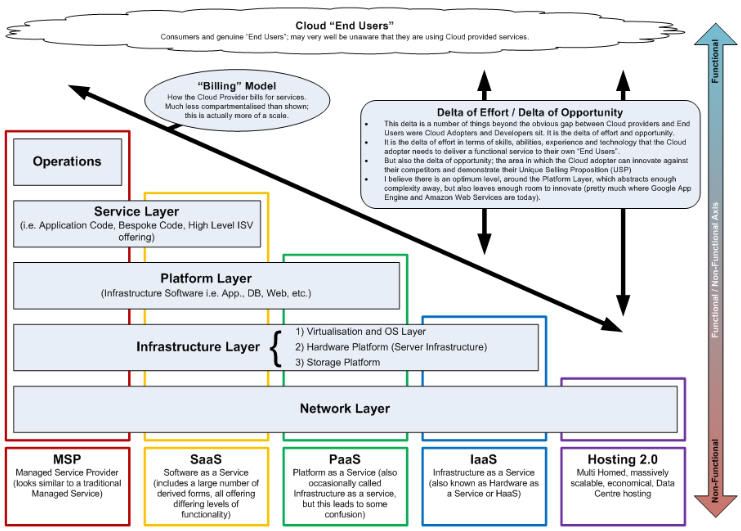
Cloud computing is a general term for anything that involves the provision of services were hosted through the Internet. These services generally are divided into three categories: Infrastructure-as-a-Service (IaaS), Platform-as-a-Service (PaaS) and Software-as-a-Service (SaaS). The term cloud computing itself inspired by the symbol cloud / cloud (hereafter still referred to as "cloud" in order to remain on the path to understanding) is often used to represent the Internet in the flow charts and diagrams.

Cloud Services has three special characteristics that distinguish it from traditional hosting. This service is sold on demand, which is usually per minute or per hour and is elastic, the user may have any desired service according to the allotted time, and service management dikelolah by provider (customer only need a computer and Internet access). Significant innovations in terms of virtualization and distributed computing, including improved access to high-speed Internet and economic improvements, have increased the attraction of people to cloud computing.

A cloud can be labeled private or public. Public Cloud sell services to anyone on the Internet.(Currently, Amazon Web Services is the largest provider of public cloud.) Private Cloud is a proprietary network or data centers that supply services were hosts to people in limited quantities. If a service provider using resources owned by a private cloud, then the result is called a virtual private cloud. Private or public, the goal of cloud computing is to provide easy access, scalable to computing resources and IT services.

Infrastructure-as-a-Service
Infrastructure-as-a-Service like Amazon Web Services provides several virtual servers with unique IP addresses and the number of blocks on demand storage containers. The customers using the application program interface (API) belonging to the provider to start, stop, access and configure the virtual server and storage containers. In the business world, cloud computing allows companies to pay only for capacity that is needed, and bringing more items to be online as soon as needed. Therefore, the model "pay according to use" also resembles the model as electricity, gas and water consumed, it is sometimes also called utility computing.

Platform-as-a-service

Platform-as-a-service in the cloud is defined as a set of software and product development tools that were hosted on the infrastructure providers. Developers to create applications on a platform provider via the Internet. PaaS Provider may use the API, web portal or gateway software installed on customers' computers. Force.com, (formerly known as Salesforce.com) and GoogleApps are some examples of PaaS. Developers need to understand that there are currently no standards for interoperability or data portability in the cloud. Most providers will not allow software made by its customers moved from platform providers.

Software-as-a-service

While the cloud model software-as-a-service, infrastructure vendors supplying the hardware, software products and interaction with the user via the portal front-end. SaaS is a very broad market. Its services can range from Web-based email to inventory control and database processing. Therefore service providers to host both applications and data, then the end user is free to use any service from the service.

Cloud Computing Pros.
Users can always use the latest version of the program he uses.
Because this program can be used users from around the world, so if there is a problem, promptly detected and rectified.
Programs can be shared, so if there is work to be completed by 10 people for example, can be worked together at different times, from where the berlainan.Jadi no longer need to have a meeting somewhere, because it will waste time , energy, and resources (electricity for air conditioning and lighting, nyamikan or offering for the participants of the meeting, not to mention the time spent chatting on the sidelines of the meeting).
Relatively cheap, because users are not burdened cost anything, except wanting additional facilities. Even data can be stored on the Internet (we do not need to know is stored in any country, or the server which one, the important data stored there is safe and accessible at any time).

Risk / deficiency use Cloud Computing
As was said as a business service, with the cloud technology you should know and make sure what you paid and what you are fully invested it for your needs using this service. You have to look at some parts, namely:
Service level - Cloud providers may not be consistent with the performance of the application or transaction. This requires you to understand the service level you get on the transaction response time, data protection and speed of data recovery.
Privacy - Because other people / other companies also make the possibility of hosting your data will be out or read by others without your knowledge or approve of you.
Compliance - You must also consider the regulation of the business you have, in this case theoretically cloud service providers are expected to equate the level of compliance for data storage in the cloud, but because the service is still very young you are expected to be very careful in terms of data storage.
Data ownership - Is your data still belongs to you so that data stored in the cloud? This question may be a little weird, but you need to know such things happened to her Facebook are trying to change its terms of use aggrement who question this.
Data Mobility - Are you able to share data between cloud services? cloud, and if you terminate your relationship how to get your data back? What format will be used? or can you ensure coffee from her data has been erased?
If the IT industry just to explore some cloud cloud technology is already well-established service and can be considered such as an e-mail service. However, for security matters, with internally developed IT infrastructure industry into a cloud model will be better.
The steps that need to be considered in applying the Cloud Computing on the IT industry are as follows:
· First step you should do is learn from the cloud service contract system. make sure every process to be simple, it can be repeated again and add value to your business.

· Second, you must identify what services you can use within the cloud and which should be internal. This is very important for you to know about the system and service cores that can be utilized by your business. and would recommend that you categorize your business based on some element of risk from the use of cloud services.

· Last step, you have to do sourcing strategy to get a very low cost, but has the scalability and flexibility for your business needs. This includes consideration of the ownership and mobility of data protection, compliance and some elements, as well as traditional IT contract.

Conclusions and recommendations

Cloud Computing (Cloud Computing) is the combined use of computer technology ('computing') based development and Internet ('cloud'). Clouds (cloud) is metefora from the internet, as the clouds that often depicted in computer network diagrams. As a cloud in computer network diagrams, clouds (cloud) in Cloud Computing is also an abstraction of a complex infrastructure that hid. He is a mode of computing in which information technology-related capabilities are presented as a service (as a service), so users can access it via the Internet ("in the cloud") without knowledge of it, an expert with it, or have control over the technology infrastructure that helped. Cloud Computing is described as a paradigm in which information is permanently stored in servers on the Internet and temporarily stored on a user's computer (client) includes desktops, tablet computers, notebooks, wall computers, handhelds, sensors, monitors and other another.

For users who want to use Cloud Computing should take into account the security of our data will be saved or if, for once we agree with Cloud Computing then we submit our data to the provider of such service providers.
Use speed internet access is sufficient, because this is very important for our data access needs.

REFERENCES
Arema. 1998. 10 Basic Questions About the Internet and Intranet.
Gratitude, Mark Ade. 1999. Web applications with PHP. Sydney: University Gunadarma.
Sidik, B. Web programming with PHP. Revised Edition-2. (Bandung: Informatics, 2004).
http://en.wikipedia.org/wiki/CloudComputing
http://www.komputasi.lipi.go.id
http://www.sun.com/featured-articles/CloudComputing.pdf
read more...

Know the RIA (Rich Internet Application)


Information technology both in terms of software and hardware is growing rapidly. This we can feel with us more easily communicate with others. Currently, we can access the internet from almost anywhere and at anytime provided we have adequate tools.

Talking about the Internet, first we can only obtain information on the internet that are one-way from. However, today, we not only get information but also can share information with other Internet users. Internet today has the character of the user by the user and for the user.

One of the technologies to treat the user in using the Internet is a Rich Internet Application (RIA). With the RIA, the user will get a different experience when using the Internet. On Internet sites based RIA, user convenience is usually something that most major.

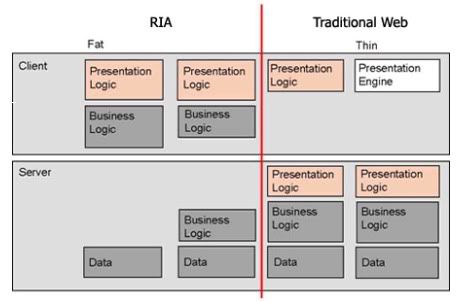
Rich Internet Application is a technology that combines the advantages of web based and desktop applications. RIA presents a beautiful visual interface and interactive. Nature does not depend on an operating system makes the RIA can reach many more computer users.

The following are general characteristics of the RIA:

1. Responsiveness: As a web application, RIA has a very striking difference with conventional web. RIA does not reload the page when a button or link is clicked. RIA update only certain parts when we perform an action. While the conventional Web, the page will be updated as a whole when we take action.

2. Can do many things: By using RIA, we could do something like what we do on a desktop application. High level of interactivity that allows the developer to move the features of a desktop application into a web application. RIA has many applications we can use such as word processors, instant Messenger's swing, and so forth.


3. Reach More Users: RIA can be run on any operating system with hardware specifications are not necessarily high. Provided that the operating system can run a browser. RIA can be run properly.

4. Communication becomes easier: By RIA, we can use a lot of media to do something. For example:

  • Text-based chat, for example via Yahoo! Web Messenger's swing, Gmail Chat, eBuddy, Meebo, Facebook Chat
  • Audio-Video Conference via Gmail Chat Videos
  • Video Streaming on Youtube, Metacafe, DailyMotion
  • Sharing on Google Docs, Facebook, Scribd, Google Calendar
  • Server Push on Facebook, Gmail, Google News


RIA Developer Technology

There are several device-based technologies to build RIA applications, namely:

1. AJAX and Javascript

AJAX stands for Asynchronous JavaScript and XML. This technology is old players who are also still used by large companies every maker RIA based applications. Some examples of AJAX-based application that is easy to find on the internet is Wordpress, Facebook, and several Google products like Gmail, Calendar, Docs, Maps. AJAX-based applications must be tested on every browser because on some browsers, AJAX will be treated differently.

2. Flash

Flash is very much we have encountered on the internet. Some are in the form of advertising, animation, the site profiles to applications that are specific. For even Facebook users are already familiar with the application of artificial Playfish Facebook. All were created using Flash.Then adalagi Yahoo! Web Messenger, which is one example of a Flash-based application built using Flex. This Flash-based applications are browser friendly, so this could be the way of Flash applications on any browser so long as the browser has Flash Player installed accordingly.

3. Java

Just like Flash, Java-based applications require an additional application called the Java Runtime Environment (JRE) in order to run smoothly on your browser. Today, Java-based applications can not compete with other applications based on AJAX or Flash.

4. Silverlight

Silverlight is a product developed by Microsoft that is used to create a RIA based applications.Just like Java and Flash, Silverlight-based applications to run requires a plugin. Currently, many sites that already use this technology to build RIA applications. However, its popularity still lose when compared with AJAX and Flash.

5. JavaFX
read more...